Credential
Filed Under — Wine · Service · Standards
Founded 1969 in London by a small group of British wine and hospitality figures to establish educational standards for beverage service in restaurants and hotels. The Americas chapter was formed in 1986 and now administers the credential ladder for North America.
A four-tier examination structure: Level I — Introductory Sommelier (two-day course and written exam) · Level II — Certified Sommelier (theory exam, forty-minute blind tasting of six wines, forty-minute service exam) · Level III — Advanced Sommelier (multi-day course; expanded theory, tasting, and service; roughly thirty percent pass) · Level IV — Master Sommelier, the terminal credential. Three-part exam (Theory, Tasting, Service) administered over several days. Fewer than two hundred eighty Master Sommeliers worldwide; widely considered one of the most rigorous credentialing examinations in any profession.
Level I Introductory Course & Exam · February 2006, Toronto
Level II Certified Sommelier · January 2011, New York
Level III Advanced Sommelier Course · October 2012, Washington, D.C.
Credential
Filed Under — Wine · Spirits · Education · Examination
Founded 1977 in the United States as a nonprofit dedicated to advancing wine and beverage education across North America and abroad. Hosts an annual conference; publishes study guides, regional reference materials, and the underlying curricula for its certifications. Membership is wine educators, distributors, sommeliers, hospitality operators, importers, and serious students of the trade.
Certification ladder: CSW — Certified Specialist of Wine · proctored exam covering wine theory, the world's wine regions, viticulture, viniculture, and service. CSS — Certified Specialist of Spirits · the spirits-side counterpart — distillation theory, spirits categories (whisky, brandy, vodka, gin, rum, agave spirits, liqueurs), and service. CWE — Certified Wine Educator · the advanced credential, combining theory with sensory and teaching evaluations. Specialty paths additionally exist for sake and the wines of Spain, Portugal, and Latin America.
Professional Member 2011–2020. CSW · February 2012. CSS · May 2012.
Credential
Filed Under — Wine · Education · Working Knowledge
The Certified Wine Professional (CWP) is the CIA's credential for working hospitality professionals, sommeliers, chefs, and beverage operators. Conferred at CIA Greystone, the institute's Napa Valley campus (opened 1995, in the historic former Christian Brothers Greystone Cellars in St. Helena), through the Accelerated Wine & Beverage Program — an immersion designed to produce industry-ready beverage practitioners rather than collectors or hobbyists.
Curriculum: viticulture and viniculture from soil to bottle · sensory analysis and blind-tasting protocols · food-and-wine pairing theory · wine service standards · the major wine regions of the world by region, varietal, and producer · winery visits across Napa, Sonoma, and the broader North Coast. The program closes with blind-tasting exams, written examinations, and a wine-program design project. Distinct from the Court of Master Sommeliers track in emphasis: the CWP trains the operator who runs the program, not only the sommelier who pours the bottle.
Awarded May 2012 alongside the AWBP graduate certificate. The class included Flavor Napa Valley and the Worlds of Flavor conferences as practicum components.
Affiliation
Filed Under — Wine · Trade · Professional Membership · Lineage
The name carries an older French inheritance. In medieval and early-modern France, the sommelier was a household officer in charge of transporting and managing his lord's provisions — bread, wine, salt, candles, table linens — a logistics role at the noble courts, descended from the Old French sumalier (a pack-animal driver). By the eighteenth century the position had specialized into keeper of the cellar, working under the rules of the trade corporations. The Le Chapelier Law of 14 June 1791 abolished those guilds in Revolutionary France, dispersing the noble households and releasing their cellarmen into the new commercial restaurants of Paris — the migration that built the modern profession.
The Guild of Sommeliers, today, is a contemporary online inheritor of that older trade-tradition. Founded 2004 by working sommeliers as a private online community for the trade: palate exchanges, exam study materials, technical correspondence between professionals at a moment when the institutional knowledge of the profession still moved largely through apprenticeship and tasting groups. Rebranded GuildSomm circa 2014.
Today the Guild functions as the working library of the wine industry — deep-dive technical reports on every meaningful wine region (Burgundy, Champagne, Mosel, Rioja, Etna, the Loire, the Wachau, Jura, Sherry country, the entire New World), expert interviews, podcast series, certification study tracks for the Court of Master Sommeliers and the Master of Wine, and a vetted member directory. The membership is active sommeliers, hospitality operators, importers, growers, journalists, and the occasional honest amateur.
Professional Member 2007–2020 — joined in the Guild's earliest era, when membership was by application and the digital library was still being assembled by the founding sommeliers themselves.
Affiliation
Filed Under — Gastronomy · Ritual · Robe
The world's oldest gastronomic society. Founded 1248 by King Louis IX as the goose-roasters' guild — the Ayeurs de l'Oye. Refounded 1950 in Paris, where it has remained.
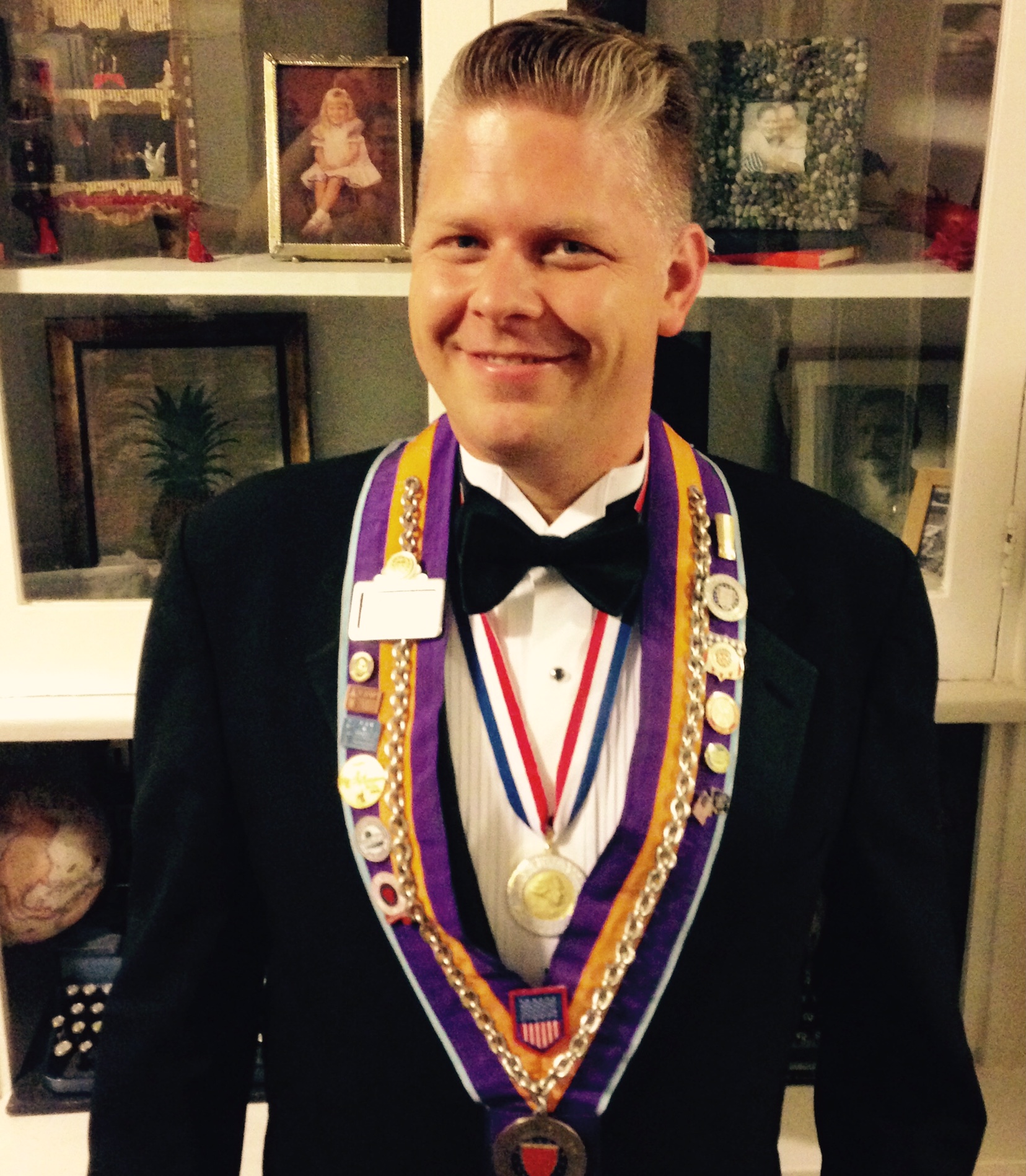
Inducted 2009 as Maître de Table Hôtelier — the rank reserved for hospitality professionals charged with the care of the table. Bestowed by ribbon, medal, and ceremonial accolade with the flat of a knife on either shoulder.
Regalia, in order of bestowal: green-and-gold ruban at the neck · pendant medal · embroidered cape for the Grand Chapitre. Pictured in Plate III.
Honor received: the Brillat-Savarin Young Professional's Medal of Merit — the Chaîne's honor roll for hospitality professionals under thirty-five, named for Jean Anthelme Brillat-Savarin (1755–1826), French gastronome and author of Physiologie du goût (1825), who wrote: “Tell me what you eat, and I will tell you what you are.”
Awarded for excellence in service, scholarship, and contribution to the gastronomic arts. Bestowed at the Grand Chapitre by the Bailli, with the same ceremonial accolade given at induction. Paired with two Chaîne des Rôtisseurs Scholarships, 2014 & 2015.
Membership concluded 2020.
Affiliation
Société Mondiale du Vin
Filed Under — Wine · Esoterica · The Inner Cellar
A confraternity within the Chaîne des Rôtisseurs, reserved for those whose livelihoods are sworn to the grape rather than to the spit. Members are inducted in candlelight, by a register kept in a back room of the chapter house — a black-bound book signed by every Professional du Vin since the order's founding. The ceremony is short. The motto is shorter.
Inducted 2009. The accolade is administered with the flat of a knife, as in the parent order, but the cup distinguishes the rite — a footed silver tastevin filled with a wine the candidate is expected to identify before swallowing. The ribbon is a deep violet, knotted at the throat. The vow is brief, in French, regarding stewardship of the cellar and the dignity of the work.
Where the Chaîne keeps the kitchen, the Mondiale keeps the cellar. The signs and pass-words are exchanged at the threshold; what passes within is filed nowhere. Solvitur in calice — what cannot be solved at the table is solved in the chalice.
Membership concluded 2020. The book remains.
Affiliation
American Institute of Wine & Food
Filed Under — Wine · Food · Education · Public Mission
Founded 1981 by Julia Child, Robert Mondavi, and a small group of American chefs, vintners, and food writers to improve the appreciation, understanding, and accessibility of food and drink in the United States. Independent, educational, nonprofit.
Operates regional chapters across the country and runs Days of Taste, a program that teaches elementary-school students where their food comes from. Awards scholarships to culinary, hospitality, and beverage students through its national and chapter funds. The organization is the institutional descendant of the conviction that civic life improves when its citizens understand what is on their plates.
Professional Member 2010–2020. AIWF Scholarship recipient at the Culinary Institute of America, Hyde Park.
Affiliation
Filed Under — Food · Awards · The Dean of American Cookery
Founded 1986 to honor James Beard (1903–1985) — cookbook author, teacher, and the man Julia Child called “the Dean of American Cookery.” Headquartered at 167 West 12th Street in Greenwich Village, Beard's former home, now operating as a year-round culinary salon: visiting chefs cook three- to five-course dinners for members and the public.
The Foundation administers the James Beard Awards — the unofficial Oscars of American food — recognizing chefs, restaurants, books, journalism, and broadcast media. Restaurants Woody helped run have been recognized at the foundation: Bracero Cocina de Raiz as a 2016 Best New Restaurant Semifinalist, and Chef Carl Schroeder (Arterra, Marriott Del Mar) as James Beard California Chef of the Year. Foundation impact programs additionally cover sustainability, equity, and policy advocacy in the food system.
Professional Member 2010–2020. Volunteer cook, James Beard House, NYC (2010); Sommelier, James Beard Awards (2011).
Training
Filed Under — Embodiment · Men's Work · Initiation
A contemporary initiatory community for men, founded 2018, in conversation with the somatic, ritual, and mythopoetic traditions of men's work. Concerned principally with the kind of man one becomes when the work is undertaken in earnest.
EMX (Embodied Masculine Experience) — four-day initiatory intensive. Somatic practice, breathwork, ritual, brotherhood, and the structured inquiry into shadow and integration.
LT1 (Leadership Training 1) — multi-month leadership and facilitation track. Mentorship, embodiment practice, and the design of brotherhoods that hold their own weight.
The Summit — annual gathering. Attended 2025, Washington — workshops, keynotes, ritual, and brotherhood at scale.
Continuing Education
MAPS · Psychedelic Science
Filed Under — Conference · Continuing Education · Religious Freedom
Attendee, Multidisciplinary Association for Psychedelic Studies annual Psychedelic Science conference, 2023.
Attended specifically to deepen study of the Religious Freedom Restoration Act and the legal frameworks under which plant-medicine churches and psychedelic-religious communities operate in the United States — incorporation, doctrinal sincerity, sacrament-safety protocols, and member accountability. Source materials include the Chacruna Institute's RFRA & Best Practices Guide.
Training
Filed Under — Leadership · Inquiry · Communication · Ontology
An inquiry-based education in the linguistic foundations of being — the formal continuation, since 1991, of Werner Erhard's est (Erhard Seminars Training, 1971–1991). Distinct from therapy; distinct, also, from coaching. Concerned principally with the relationship between language, action, and possibility.
The Landmark Forum — three-day foundational course. Distinctions on integrity, the completion of the past, the difference between what happened and the story of what happened, and language as the medium in which reality is generated rather than merely described.
The Advanced Course — second weekend. The question of who one would be if it were possible. Distinctions on default ways of being, projection, and the relationship between freedom and choice.
Self-Expression & Leadership Program (SELP) — ninety-day community-project intensive. Distinctions on leadership, breakdown and breakthrough, registration, and the design of a project that did not previously exist.
Communication: Access to Power — listening as access to power. The network of conversations as the substrate of organization.
The Wisdom Course — year-long inquiry into living an extraordinary life. Distinctions on time, the “winning game,” and the structures of identity that outlast their original purpose.
Judge, Sommelier Challenge, San Diego (2014–2019) ·
Advisory Board, Cellarmaster & Speaker, SommCon, San Diego (2015–2019) ·
Sommelier, Pebble Beach Food & Wine (2016–2020) ·
Sommelier, Los Angeles Food & Wine (2016–2019) ·
Advisory Board, Kitchens for Good, San Diego (2016–2018) ·
Culinary Advisor, Art Institute of California, San Diego (2015–2017) ·
CIA Alumni Champions (2016–2018) ·
Sommelier, Aspen Food & Wine (2019) ·
Sommelier, World of Pinot Noir (2020) ·
Speaker, CIA Beverage Conference (2020) ·
Management, The French Laundry & Ad Hoc, Yountville (2013) ·
Volunteer, Auction Napa Valley at Meadowood (2012) ·
Sommelier, Restaurant 1833, Monterey (2012) ·
Culinary, Fatty Cue, Brooklyn (2011) ·
Sommelier, James Beard Awards (2011) ·
Volunteer, Worlds of Flavor, St. Helena (2011) ·
Culinary, James Beard House, New York (2010) ·
Volunteer, Berry Good Foundation (2015–2016) ·
Sommelier, MoPA 100-Point Tasting, San Diego (2007–2009).